


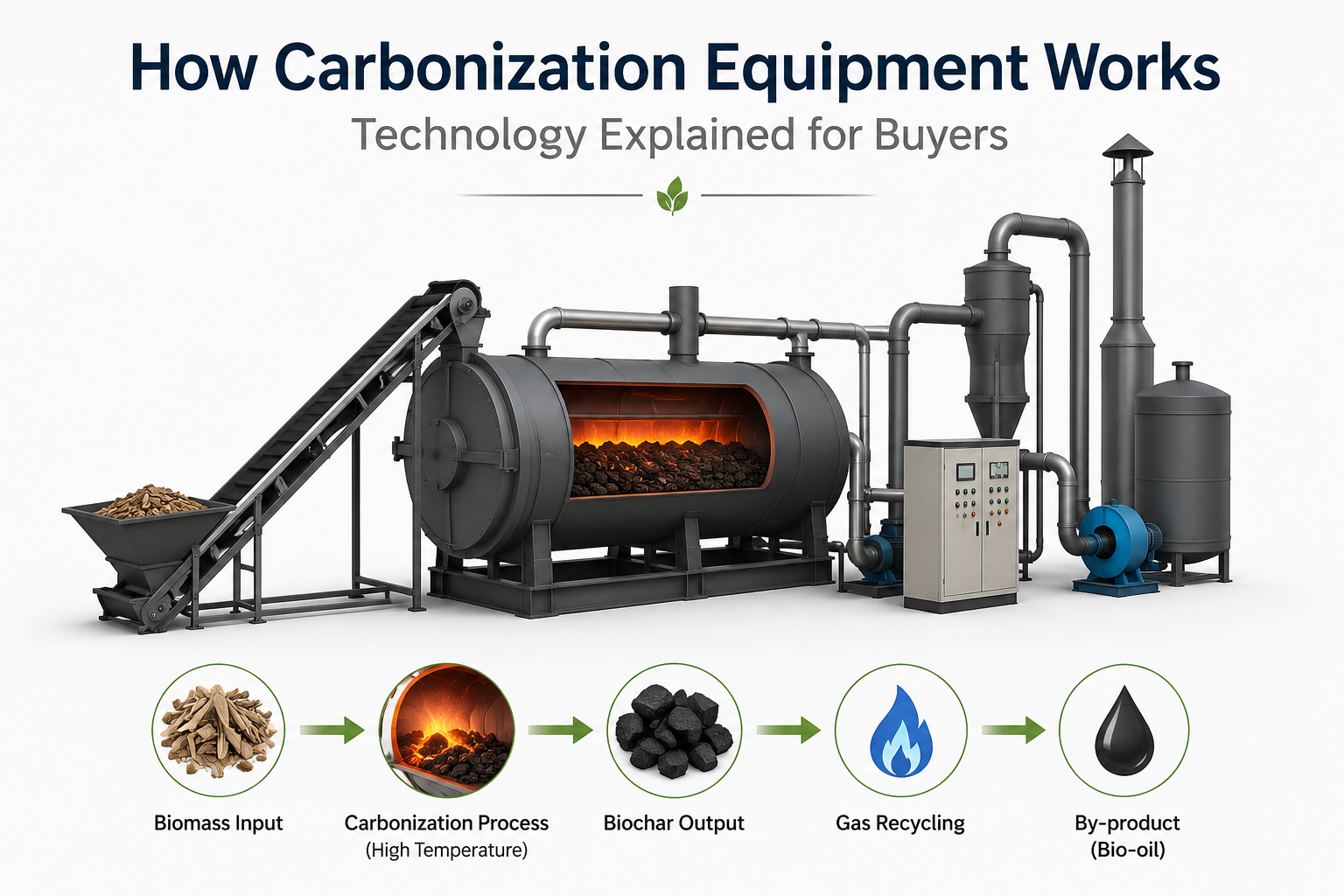
The carbonization equipment uses raw organic matter to produce charcoal, biochar, or activated carbon. An overview of this technology enables more informed buying decisions. This guide explains the science behind carbonization equipment and outlines the essential steps, components, and technologies to consider before investing.
Carbonization is a thermal treatment technique that converts organic matter into an inedible substance. This takes place in an oxygen-deficient environment. This carbon comes with no volatiles or water. It is different from traditional burning, which may result in ash. Carbonization retains much of the material's structure and will ultimately transform into a more stable carbon.
Carbonized products, like charcoal and biochar, still have some beneficial properties, like the porous structure and carbon content, which is why. They are useful as a fuel, for soil improvement, and for water filtration.
There are basically three stages of processing for many kinds of carbonization equipment. Every stage has a defined function to carry out the necessary changes from raw material to the finished carbon product.
Raw materials may contain some moisture and need to be dried before further processing. The drying stage is to evaporate water from the materials under controlled heat before the main carbonization stage. This step helps to increase efficiency and minimize energy loss later in the process.
Pyrolysis is a process in which material is heated in the absence of oxygen at high temperatures. This degrades the organic matter, producing gases and solid carbon matter. This stage is the primary step in the carbonization process.
The carbon product after the pyrolysis process needs to cool before packaging or further processing. Fast cooling during the cooling process in an oxygen-free atmosphere ensures the material doesn't reignite or degrade in quality.
What are the effects of temperature control on the carbonization equipment?
Carbon quality and yield depend on temperature control. Increased temperatures increase carbon production but decrease overall production. Lower temperatures yield a broader distribution of the product but also increase production.
Equipment should be reliable, such as accurate temperature monitoring. This helps operators ensure consistent quality across different production sets.
Knowing the primary components of carbonization machines helps buyers assess their quality. Each component has a specific function in the process.
The furnaces or reactors.
This furnace, also known as the reactor, is where carbonization is completed. This component should be able to withstand high temperatures and should provide for a low-oxygen environment during the process.
The feeding system supplies raw material to the furnace. Some equipment is manually loaded, and more sophisticated equipment is equipped with a feeding mechanism that ensures continuous operation.
Combustible gases are emitted during the pyrolysis phase of carbonization. Gas recovery systems capture these gases and can often be used as fuel for the process. This enhances the overall energy efficiency and reduces operating costs. For larger systems operating around the clock, there are also advanced systems that convert excess recovered gas into electricity, improving efficiency.
Carbonization equipment is mainly classified into two types: batch and continuous systems. This way, buyers can select equipment suitable for their production level.
· In batch systems, a batch of material is processed at a single time. After processing, the furnace contents are emptied and refilled for the next batch. This is suitable if the operation size is small and the daily output amount is not large.
· In continuous systems, the material can be fed into the plant without stopping between batches. This is ideal for bigger businesses requiring reliable, high-volume production working schedules.
Why is emission control important in carbonization equipment?
Carbonization may form smoke or gases, adversely affecting air quality if not properly controlled and managed. These are gathered and filtered out in emission control systems prior to release. This helps in industry compliance with environmental laws and minimizes the effect of pollution.
Buyers need to ask the manufacturer for details on the type of emission control incorporated into the equipment design.
The Functions of Automation in Modern Equipment
Nowadays, many carbonization machines come with automatic controls. The use of automation minimizes manual monitoring and maintains standard conditions throughout the process.
A few manufacturers now offer remote monitoring systems, allowing operators to monitor equipment from another site. This helps identify problems as quickly as possible and minimizes undesirable production downtime.
This is particularly beneficial for facilities with multiple carbonization units operating simultaneously, as manual monitoring would require a large workforce.
· Carbonization equipment does not necessarily work for all types of raw material. These materials exhibit different behavior during heating, including wood, agricultural waste, coconut shells, and sludge. The equipment should be tailored to the feedstock intended for processing by a buyer.
· Inquire with manufacturers whether their machines have been tested with your raw material. This is to ensure compatibility before buying.
· Moisture content, particle size, and density of the feedstock are all factors that could affect a machine's performance. Using a detailed feedstock description allows manufacturers to suggest an optimal equipment configuration.
What Matters for Buyers about the energy efficiency of Carbonization Equipment?
Buyers should inquire about gas recovery systems and insulation levels. These features directly impact the equipment's fuel consumption during operation. Well-designed equipment can impact total energy savings over the long run.
Requesting Consumption Data
Energy consumption data should be obtained from manufacturers to estimate costs before purchase accurately.
The design of carbonization equipment directly impacts the quality of carbon products. Stable temperature control, proper sealing, and effective gas management all help to ensure consistent, good-quality output levels.
Inconsistent results, such as carbonizing one piece but not the next, or failure to dry the product, can be caused by poorly designed equipment. This affects the usability and resale value of carbon products for buyers when finished. If available, compare the output from multiple manufacturers through samples. Specifications are not always sufficient to capture the quality differences often revealed by physical testing.
· Carbonization takes place at high temperatures and may even involve combustible gases; thus, safety is a critical design consideration. Pressure-relief mechanisms, safe sealing systems, and easy-to-read safety markings throughout the machine have been built into reliable machines.
· Installation safety should be confirmed by verifying that the equipment complies with applicable safety standards. This ensures worker protection and decreases accidents during normal operation.
· Safety is also a long-term requirement that involves regular maintenance checks. Worn seals and broken pressure relief valves can cause problems over time and should be addressed as part of routine equipment care.
Knowledge of how a carbonization machine operates enables buyers to make more informed buying decisions. Knowledge of temperature control, automation, emission systems, and feedstock compatibility helps customers choose equipment suited to current and future production needs.
1- What is a good place to purchase carbonization equipment for a retail business?
Purchase from manufacturers that can accommodate bulk shipments. This generally leads to more competitive prices and uniformity of product quality for large orders.
2- Where to purchase carbonization equipment wholesale at discounted prices?
Analyze pricing quotes from different manufacturers and discuss wholesale pricing tiers. Many larger orders generally equate to lower cost.
3- How to get a supplier of carbonization equipment that offers customization?
Check for manufacturers with in-house engineering projects. Many provide customization for different feedstocks and production scales.
4- Can any of the carbonization equipment suppliers provide a bulk deal with customization at a reasonable price?
Yes, several manufacturers offer bulk pricing and customized services. Discuss your particular project requirements with suppliers directly.
5- What is the approximate time needed for carbonizing?
Feedstock type and equipment design will determine processing time: a few hours with a batch system or continuous with larger systems.
The carbonization equipment operates at low oxygen with organic wastes and generates three produc
READ FULLThe carbonization equipment uses raw organic matter to produce charcoal, biochar, or activated ca
READ FULL