


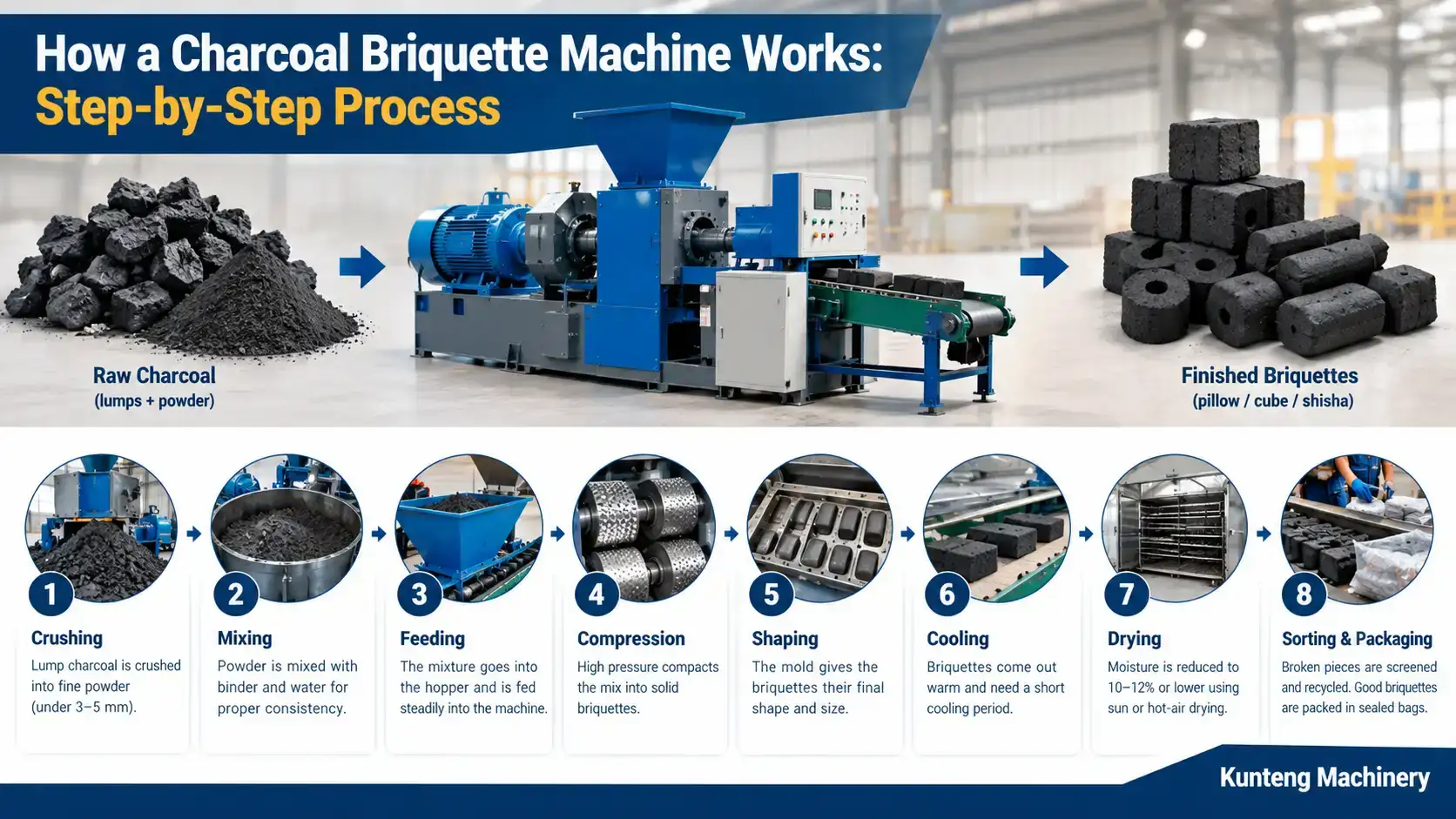
A Charcoal Briquette Machine takes loose charcoal powder and presses it into solid, uniform blocks that burn longer and travel without crumbling. Charcoal has no natural stickiness, so the machine cannot simply squeeze the powder together. The result depends on how the material is prepared before it enters the machine and how the blocks are handled after they leave it.
The steps below follow one batch from raw charcoal to packed briquettes. The same basic sequence serves barbecue fuel, shisha charcoal, and industrial boiler fuel, with differences mainly in mold shape and pressure. Each step explains what happens, why it matters, and what goes wrong when it is skipped.
Before the first step, you need to know which route your material takes, because the order of operations changes.
Route 1: Charcoal powder. Material that is already carbonized, such as wood charcoal, bamboo charcoal, coconut shell charcoal, or leftover charcoal fines, gets crushed, mixed with a binder, pressed, and dried. This route allows many shapes, and it is the route the steps below follow.
Route 2: Raw biomass. Low-density material such as sawdust, rice husk, peanut shell, or bagasse is pressed first and carbonized afterward. A screw extruder with a heated barrel pushes the material through a die. Heat of roughly 200 to 300 degrees Celsius softens the lignin inside the biomass, and the lignin works as the binder, so no added binder is needed. The pressed rods then go into a carbonization furnace and come out as charcoal rods. The finished shape stays limited to the rod profile of the die.
Lump charcoal comes from a carbonization furnace, and fine charcoal dust collects during handling and transport. Both go into a hammer-type crusher that reduces them to powder. The target particle size is under 3 to 5 millimeters.
Particle size matters because large pieces leave gaps inside the briquette. Those gaps become weak points, and the finished block cracks or crumbles when it is dropped or stacked. Fine powder packs tightly and bonds evenly with the binder. Spraying a little water on the lumps before crushing reduces dust, and a sieve after crushing catches oversized pieces that need a second pass.
Charcoal has no plasticity, which means it cannot hold a shape under pressure by itself. A binder supplies the missing stickiness, and this step decides whether the briquette stays in one piece.
Cassava starch and corn starch are the most common binders, usually at about 5 to 10 percent of the powder weight. A frequently used starting ratio is roughly 100 kilograms of charcoal powder, 5 kilograms of starch, and 45 kilograms of water, adjusted after a test pressing. The starch is first mixed into hot water to form a thin paste, then added to the powder.
A roller-type mixer kneads the mixture until every particle is coated. The rolling action also compacts the mix slightly, which helps the press form a denser block. Clay and molasses serve as binders in some operations, but clay adds ash and lowers the heat output, so starch remains the usual choice for fuel briquettes.
Check the consistency by squeezing a handful. A correct mix holds its shape and releases no water. A dry mix crumbles, and a wet mix sticks to the mold, deforms, and needs far more drying time later.
The prepared mix goes into the hopper at the top of the machine. A feeder or screw conveyor then moves it into the compression chamber at a steady rate.
A steady feed matters because pressure builds against whatever material is in the chamber at that moment. Surges create briquettes of uneven density, while starved cycles produce hollow or half-formed blocks. Keep the hopper covered and avoid filling it with more mix than the machine consumes in a short period, since an uncovered mix loses moisture and starts to stiffen.
Compression is the core of the process. The machine forces particles close together under high pressure, and the binder fills the remaining gaps and locks everything in place. Higher pressure produces a denser, heavier briquette that burns longer and survives drying, handling, and shipping with less breakage.
Three working principles cover most machines:
Roller press. Two rollers rotate toward each other at the same speed, and each roller carries matching pockets on its surface. The mix drops between the rollers, the pockets meet at the center line, and the powder is pressed into pillow, oval, or round shapes. This design runs continuously and suits high-volume production. Wear-resistant rollers reduce how often the contact surfaces need replacing and keep briquette density consistent over long runs.
Screw extruder. A rotating screw carries the mix forward through a narrowing chamber toward a die. Pressure builds along the screw, and the material leaves the die as a continuous rod in a square, hexagonal, round, or plum blossom profile, which a cutter then trims to length. The pressure is lower than in other designs, so charcoal powder always needs a binder in this type.
Hydraulic or punch press. A piston or hydraulic cylinder rams the mix into a closed mold under very high pressure and holds it there for a moment. The holding time lets the particles settle into a stable form. This design produces very dense blocks, which makes it a common choice for shisha cubes and similar products, although each cycle takes longer.
Machines with adjustable pressure and speed let the operator tune density and throughput to the material, the binder ratio, and the target market.
The mold or die decides the final shape, so changing the mold changes the product without changing the rest of the line. Three formats cover most orders:
Mold accuracy affects more than appearance. Uniform size means uniform burning, and uniform shape packs efficiently into bags and cartons. Custom mold configurations extend the range to sizes and shapes that buyers specify for their own markets.
Pressing generates heat and friction, so briquettes leave the machine warm and not yet fully hard. A conveyor or collection tray carries them away, and they need a short rest period while the binder sets and the surface hardens.
Handle them gently during this stage. Dropping fresh briquettes from a height or stacking them straight away squashes the soft edges and deforms the shape, and no later step corrects that damage.
Fresh briquettes still hold the water added during mixing. They must dry to roughly 10 to 12 percent moisture or lower before packing. Wet briquettes ignite poorly, smoke heavily, grow mold in storage, and crack inside the bag.
Two drying methods are common. Sun drying on racks costs nothing, but it takes one to three days and depends on the weather, so a week of rain stops production. A hot-air industrial dryer, such as a mesh belt unit, shortens the time and gives the same result in every season. A simple moisture meter confirms the briquettes have reached the target before they move on.
A final screening removes broken pieces and dust. Do not discard them. Returning the fragments to the crusher or the mixer keeps material waste close to zero.
The good briquettes go into bags, with retail packs commonly at 1, 2, or 5 kilograms and larger sacks for industrial buyers. Keep the packaging sealed and store it in a dry place, because dry charcoal briquettes absorb moisture from humid air.
The process runs in one direction: fine powder, an even binder mix, a steady feed, controlled pressure, the correct mold, gentle cooling, and full drying. Every common defect traces back to one of these stages.
Crumbling briquettes usually point to the binder ratio in Step 2 or the particle size in Step 1. Low density points to the pressure setting in Step 4. Cracks, mold, and smoke after packing point to incomplete drying in Step 7. Checking the steps in that order finds the cause faster than adjusting the machine without a plan.
Steps 2 to 5 decide most of what your briquettes look like, and our machines give you control over each of them:
Kunteng Machinery matches the right combination to your material and output target.
The carbonization equipment operates at low oxygen with organic wastes and generates three produc
READ FULLThe carbonization equipment uses raw organic matter to produce charcoal, biochar, or activated ca
READ FULL