

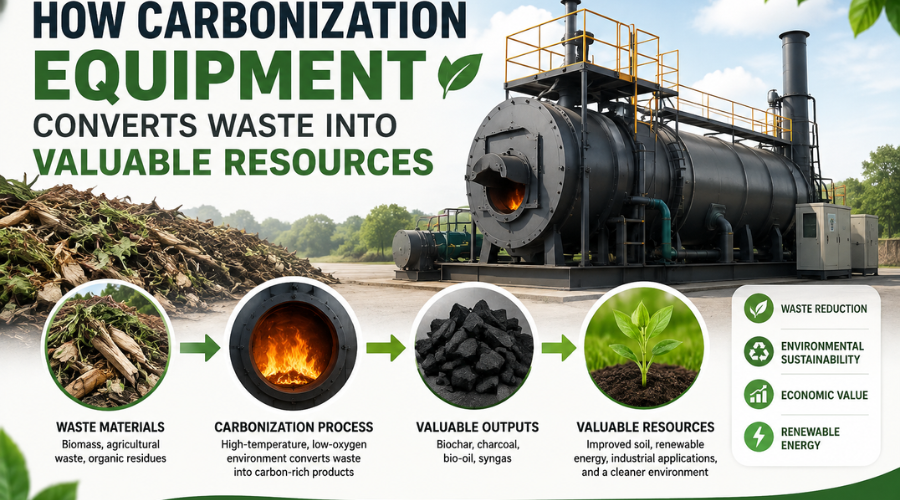
The carbonization equipment operates at low oxygen with organic wastes and generates three products: biochar (yield of 25 to 35 percent; best product: yield of 450 to 550°C); syngas (yield of 20 to 30 percent, enough to reduce energy costs by 40 to 60 percent); and wood vinegar (yield of 10 to 15 percent). The equipment is available in sizes from the small farm size ($15,000 to $40,000) to the industrial size (over $500,000), and paybacks are generally 2 to 4 years. Reactor material is important, as is emission filtration, and the supplier provides the best-known efficiency data.
Waste piles up fast. Every farm generates large amounts of crop residues. Cities produce tons of sludge and wood-chopping waste. Most of it is burnt and buried. Carbonization equipment provides an alternative. It produces valuable products out of waste such as wood vinegar, fuel gas, and biochar. This guide explains how the process works, what materials it handles, and the information buyers need before investing in the equipment.
Carbonization is a thermal process. It heats organic material under low-oxygen conditions. This will avoid complete combustion. The material does not burn away but forms carbon-rich solids, gases, and liquids.
It is usually conducted at a temperature of 300°C to 700°C, depending on the desired product. Biochar yields at lower temperatures. Higher temperatures favor gas production. In most commercial systems, the output is balanced by using an operating range for the purpose.
Both are frequently used interchangeably, but technically, there is a difference. Pyrolysis is the wider thermal decomposition reaction. Pyrolysis aimed at obtaining maximum carbon yield in the solid product is referred to as carbonization.
The Three Main Outputs of Carbonization.
Carbonization equipment is not limited to producing a single product. It typically provides three separate outputs, each with its own value stream.
Biochar is the solid, carbon-based residue from processing. The typical yield is 25-35% of the original feedstock, which varies by material and temperature. It is occasionally added to the soil for agricultural purposes, and can increase the water-holding capacity of treated soil by up to 15% to 20%.
Wood vinegar, or pyroligneous acid, is a by-product extracted during the cooling process. The yield is about 10-15% of the feedstock weight. It's used as a natural pesticide and soil conditioner in many agricultural applications.
The rest of the production is synthetic gas, also known as syngas, about 20 percent to 30 percent of the total on a mass basis. This gas is recycled to the carbonization system without any external energy cost, resulting in a 40-60 percent reduction over systems where no gas recovery is done.
Some waste material is not suitable for the carbonization system. Both moisture content and material density have a significant effect on processing efficiency.
Feedstock sources can be from rice husks, corn stalks, or coconut shells. One of the higher yields of agricultural residues is around 30-35 percent biochar yield from rice husk.
Wood chips, sawdust, and bamboo scraps are practical in terms of consistent density and moisture content of less than 15 percent when dried. The consistency results in more consistent output ratios.
Sewage sludge and animal manure may also be treated, but moisture levels can be more than 60 percent before drying. In this case, pre-drying is necessary, as excess moisture will not only consume a lot more energy but also make processing less efficient.
Cycle times will vary depending on equipment type and product batch size. In a continuous system, processing takes 2-4 hours per cycle. Smaller operations like batch systems can take 8-12 hours for each full cycle, with cooling before the biochar can be safely collected.
Which temperature range yields highest quality biochar?
The ideal temperature range is 450-550°C for most biochar applications in agriculture. The carbon range is just 70 to 85 percent, with enough porosity to allow soil water to be properly retained.
Understanding of key equipment components.
Carbonization systems consist of many important parts. Each part is a significant guide for the buyer's active evaluation of equipment quality.
This is where the actual thermal decomposition occurs. Reactor materials do play an important role here. High-grade stainless steel is more resistant to corrosion, has a rating of up to 800 degrees Celsius, and can withstand corrosion for many years even under continuous use.
After processing, output needs rapid cooling to prevent reignition of the hot biochar and to condense gases into wood vinegar. If not designed properly, a cooling system can increase cycle times by as much as 30 percent.
A purifying system removes particulates and tar from the syngas before further combustion, since syngas may be recycled as fuel. This prevents burners from clogging and improves overall system energy efficiency.
Carbonization equipment is available in various capacities, usually measured in kilograms or tons of feedstock that can be burned per hour.
Small systems process 100 to 500 kg per hour, making them appropriate for farms or those small farm groups desiring to process their own crop residue on farm.
The mid-scale process is used in 1-5 tons per hour, and is typical in small-scale regional waste management facilities or larger agricultural processors that might process multiple feedstock sources.
Industrial systems can process 10 tons of waste per hour or more and are normally used at municipal waste disposal stations or larger biochar production firms selling bulk biochar to farmers.
Consider the cost when ordering bulk equipment.
Prices vary widely and depend on capacity and automation level. Small-scale units can start around $15,000 to $40,000. The mid-scale continuous systems are typically specified between $80,000 and $250,000. Industrial-level operations can cost over $500,000 depending on automation, gas recovery, and emissions control equipment.
Return on Investment Timelines.
Payback periods range from 2 to 4 years in many operations, with payback achieved depending on the market price of biochar, the cost of wood vinegar and syngas, and the market value of the energy produced or the in-house energy demand offset.
While carbonization emits less gas than open burning, special equipment must be designed to filter emissions to meet regional air quality standards. Many systems incorporate particulate scrubbers, which can cut particulate emissions by up to 90% from unfiltered combustion.
Buyers in zones where there are harsh emissions regulations, such as the EU's Industrial Emissions Directive, must ensure that equipment will meet local VOC and particulate emissions standards.
Not all manufacturers make equipment of the same quality. Reactor material quality, reliability of automation systems, and after-sales service may differ widely among suppliers. Request verified efficiencies like biochar yields (in percentage) and energy output from real systems rather than speculations. Suppliers that provide this information, including anecdotes from their existing customers, are more likely to deliver the best equipment.
Carbonization equipment can operate at high temperatures for a longer duration, causing actual wear to reactor seals and gaskets. Most manufacturers recommend inspecting seals every 500-800 operating hours to ensure efficient processing and avoid gas leaks.
Regular ash collection is also important. Without it, loss of heat transfer over time of 10-15% may lead to unnecessary increased energy costs and increased cycle times.
The carbonization machines convert waste that would otherwise end up in landfills or be burned into useful products. Biochar has positive soil health benefits. Wood vinegar enhances natural pest control. Syngas reduces energy costs of operation. Knowledge of yield rates, temperature ranges, and equipment characteristics helps buyers select systems that process waste only when necessary and provide real, measurable benefits.
Where can I get carbonization equipment in bulk for a retail store?
Manufacturers that offer efficiency data and emissions compliance certificates offer the best chance of buying in bulk. It is important to confirm reactor material specifications before ordering in bulk.
Where to purchase carbonization equipment wholesale and at a low price?
Get a few quotes from manufacturers you know and find out the price for purchasing several units. Many mid-scale continuous systems can be more cost-effective than multiple smaller-scale systems.
Where can I find a carbonization equipment supplier who also offers customization?
Find suppliers that offer custom configurations and special feedstock handling systems. These options are often specified for customers with unique waste stream requirements.
Is there any carbonization equipment supplier who offers bulk supply with customization at low prices?
Yes, some suppliers offer bulk pricing and customization, such as capacity reduction and automation upgrades. When asking about custom configurations, it's best to inquire about minimum-order requirements directly.
The carbonization equipment operates at low oxygen with organic wastes and generates three produc
READ FULLThe carbonization equipment uses raw organic matter to produce charcoal, biochar, or activated ca
READ FULLThe selection of a waste processing machine can directly impact daily operations, costs, and long
READ FULL